
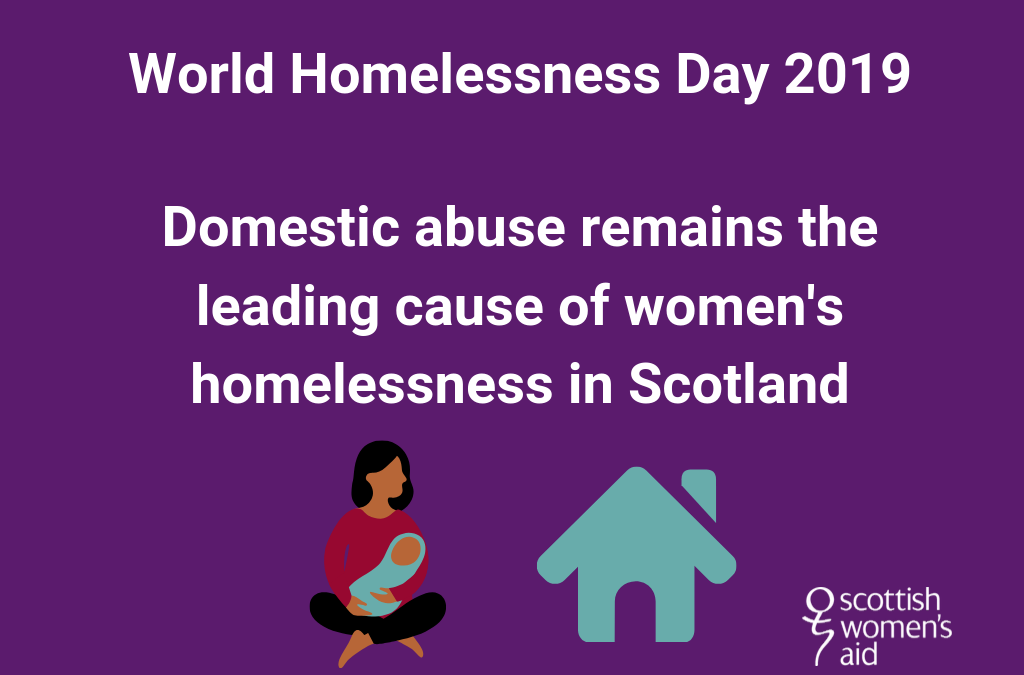
Today, 10th October 2019, marks world homelessness day. We’re also bang in the middle of Challenge Poverty Week.
For over forty years Women’s Aid groups in Scotland have provided refuge and front-line services to women, children and young people experiencing domestic abuse. We know from that work, and from years of research and campaigning, that women and children’s experiences of domestic abuse are inextricably linked to their experiences of poverty.
Women are battling an uneven playing field in the labour market, struggling with accessing and paying for childcare and facing cuts to social security that have disproportionately impacted them. Each of these issues makes women’s financial independence difficult and, in the context of domestic abuse where financial control is often a tactic, the prospect of financial independence is even further restricted.
We are working for a future with no domestic abuse, where women enjoy all of their human rights are have equal opportunity to explore all of their ambitions and aspirations. Making sure women have a safe roof over their heads, and a place for their children to call home, is one vital piece of that puzzle.
In Scotland, the leading cause of women’s homelessness is domestic abuse. Current housing policy and practice responses are based on expecting women and children experiencing domestic abuse, rather than perpetrators, to leave their homes. This means that many women looking for support are made homeless by the very services that are meant to help them; forced to leave the family home and then move multiple times.
One woman who participated in our Change, Justice, Fairness research said of this experience:
“You’re destroyed. I mean yeah, you eat, you drink, you sleep, you talk but you’re dead inside and you can feel it. You feel so down, so low, you wish the floorboards would open up and swallow you. It’s so embarrassing. Yeah, you just think, oh gosh, I should have let him kill me because that would have ended it. It’s just agony, agony, agony.”
Often women are told that their only housing option when separating from an abusive partner is to make a homeless application. Being forced to become homeless adds to the trauma of domestic abuse, and comes at huge emotional and financial cost. When considering leaving an abuser women are facing destitution and poverty for them and their children – an impossible choice to face.
We want to see that change. That’s why we, in partnership with the Association of Local Authority Chief Housing Officers, the Chartered Institute of Housing Scotland, the Scottish Federation of Housing Associations and Shelter Scotland produced a good practice guide on domestic abuse for social landlords to help them prevent women and children’s homelessness and provide a service that is sensitive to their needs.
The new guidance has been made available to every social landlord and every local authority in Scotland, meaning the potential is there to change the future for thousands of women and children.
We will continue to campaign for a gendered approach to homelessness in Scotland, and we will keep calling for measures that will help ensure women can stay in their homes and that abusers are the ones who have to leave. However, on World Homelessness Day, this guide feels like an invaluable tool in improving the responses to women, children and young people experiencing the trauma of coercive control.
If you would like further information on the guidance, please contact media@womensaid.scot
For anyone experiencing domestic abuse, or those concerned about someone else, Scotland’s Domestic Abuse and Forced Marriage Helpline is available 24/7: 0800 027 1234.
