

This September, Equally Safe in Practice (ESiP) and seven local councils from across Scotland are marking the end of a pilot phase that has seen hundreds of council staff engage with newly developed learning modules and an animation. Since 2021, Angus Council, Dundee Council, Falkirk Council, Fife Council, East Renfrewshire Council, South Lanarkshire Council and West Dunbartonshire Council have participated in a pilot to test three new learning modules in practice, which make up part of the Equally Safe in Practice framework for workforce development.
What was piloted?
Three e-learning modules – Together for Gender Equality, Understanding Domestic Abuse and Understanding Sexual Violence – and the competency frameworks that underpin them have been developed collaboratively with local and national partners in the violence against women and girls sector. The modules form the foundations of the ESiP Framework and are Group 1 of a workforce development framework that ranges from Group 1 through to Group 6, with targeted learning for each professional level. This means they’re aimed at staff across all levels, roles and responsibilities. The modules intend to build a basic understanding of gender, gender inequality and the dynamics and impact of violence against women and girls. Learners are supported to consider what they can do within their role to respond to those affected, and how they can contribute to making their organisations and communities safer and more equal.

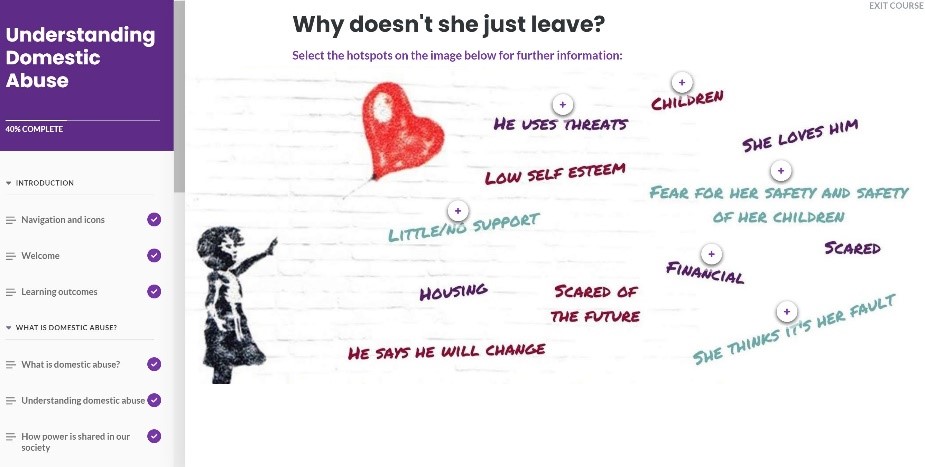
These modules focus on strengthening the everyday practice of workers across all sectors, to improve responses and outcomes for our communities – particularly women, children and young people.
Each module covers basic information about different forms of violence against women and girls, the impact on individuals and on our communities, and has a call to action which encourages learners to think about their own practice and what they could improve or strengthen.
A combination of quizzes, video, audio, case studies and reflective prompts mean that the modules take learners on an interactive journey to understand the key concepts and explore statistics, individual experiences and examples in difference contexts. Within the e-module they can also jump to a support and helpline section at any time to access information about reaching out for support or advice.
How did the pilot work?
Throughout the pilot, council steering-groups led their own approaches to testing, with different staff teams and departments engaged. Target groups ranged from housing to HR, senior leaders, social workers and managers. Councils enrolled their staff in the three e-learning modules, and coordinated follow-on discussion sessions to reflect on the key topics and consider what it might mean for them in their practice.
Some councils opted to make the modules mandatory for the pilot duration, while others targeted specific staff groups and for some it was best to open the module across departments to achieve a real mix of learners. These tailored approaches have offered ESiP the chance to look at different models for implementing the learning. For some organisations the training aligns with specific policies and priorities, whilst for others it is a complementary resource that will sit within their learning and development programme, or become part of mandatory induction. Participating councils are now exploring how these modules can be implemented going forward to have maximum impact, reach and sustainability – with support from ESiP where possible.
As we reach the end of the pilot phase, over 1140 learners enrolled to complete all three modules, and they have shared their feedback with us about what they have learned, what they see differently and what they intend to do next. Here is a snapshot:
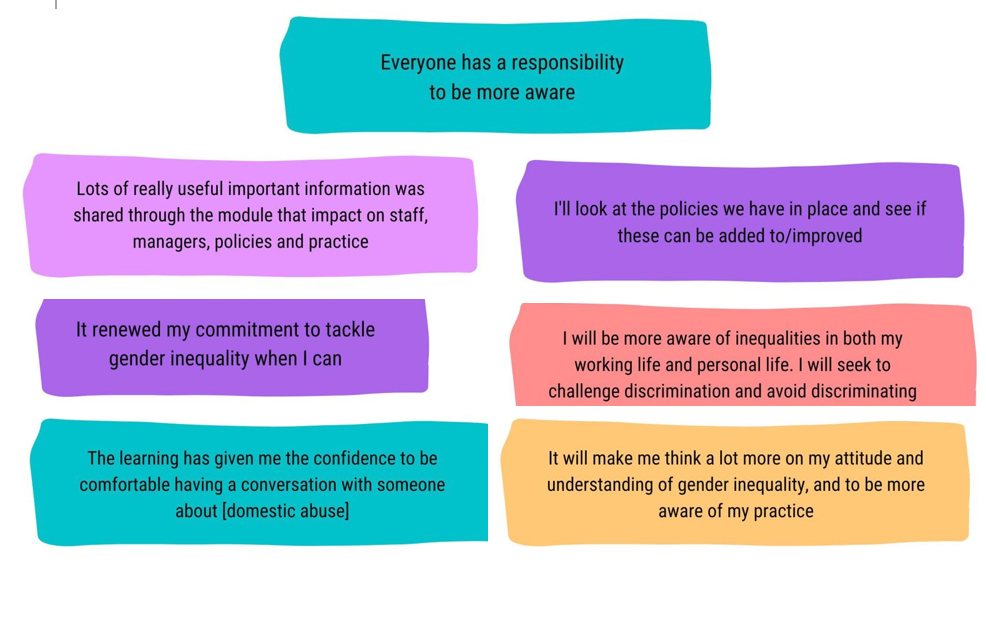 Key learning and reflections
The majority of learners reflected that each e-module had improved their knowledge and increased their confidence in talking about the core topics.
For many who responded to our evaluation survey, they could see clear ways they will use the learning in their practice – from considering their interactions with colleagues or the public more carefully, to challenging assumptions and recognising the importance of listening, believing, supporting and signposting.
For ESiP, one of the key reflections from the pilot relates to a need to find a way to embed this learning, so that these topics and concepts can be explored in more depth, and applied to practice. One-off training may help learners to increase their awareness or learn new information in the short term, but there is a critical next step to sustain that learning which needs the support of managers, leaders and the whole organisation to create an environment where learners can put that knowledge into practice.
Throughout the pilot, most councils were able to coordinate discussion sessions with their teams to reflect on what was learned and to open up different perspectives, opinions and ideas. Facilitating these spaces can be difficult when organisations and staff teams are under time and resource pressures and ESiP have needed to find new ways to support teams to have these discussions. ESiP have responded to this by creating a Module Toolkit which will accompany the modules and act as a supportive document for anyone looking to embed this learning for their teams, departments or whole organisation.
For some of the council steering groups, the learning modules and discussion spaces have contributed to an ongoing conversation about equality and violence against women and girls within their council. For others, it kick-started a new and much-needed conversation that many had assumed wasn’t needed. For one council in particular, the participation of leaders in the pilot has built an important sense of momentum and potential for change.
How can I access the modules?
From the end of this month, the modules are available to other organisations and councils looking to increase the knowledge and skills of their workers, or to embed them into their learning programmes. The modules will be accompanied by the Module Toolkit which contains an overview of the core principles of the ESiP Framework, a knowledge and skills framework for the modules and a range of different approaches, tools, resources and workshops to support reflective discussions.
To find out more or to access the modules, or if you would like to read more about the pilot phase, please contact the ESiP Administrator Gillian.Harrold@womensaid.scot

