
Blog post by an anonymous member of our Survivor Group. We thank her for sharing her experiences here.
Content warning: domestic abuse, shame, harm to children. Read with care. Information on where to get support is at the end of this post.
Two years ago, during the first lockdown, I told my partner to leave. It was one of the hardest things I’ve done.
His behaviour and choices were becoming more controlling and abusive and for the first time ever I saw him for what he was – a master manipulator. I also saw myself. My relationships through the course of my life, with men in particular, followed the same pattern and, whether I realised it or not, these were often abusive relationships. It was incredibly difficult for me to admit that I had spent most of my adult life loving men who were abusive. My life had been dictated by these relationships – I’d lost jobs, homes and friends. But the worst thing was the impact these relationships had on my daughters. I blamed myself 100%.
Full of disgust for myself I tried, in vain, to understand how and why I ‘chose’ men like this to form relationships with. Although I was embarrassed, I knew I had to speak out.
And so the difficult conversations began – with the police, recounting the abuse and feeling it was happening all over again. With the neighbours – awkwardly asking them “if he drives up the street and you see him before I do, please let me know.” With the emergency locksmith when I got the locks changed – “Yeah, I lost my keys, what a numpty, eh?”. With the school – “Sorry she can’t come to school today because she’s frightened that her dad will turn up again and humiliate her in the playground.”…And so it continued, reliving the abuse each time I needed to reach out to keep us safe.
But by far the most difficult conversation was with my daughters. During this conversation I did a lot of listening. It wasn’t nice. Mainly questions like “You won’t let him back again, will you?” “Why can’t I stop shaking Mum?” and, the worst one of all, “Why did you stay with him?”
The last question I honestly couldn’t answer. I didn’t know. I felt something that wasn’t just sorrow or regret. I began to realise that what I was feeling was an overwhelming sense of shame. I’d never really thought about shame before – it was something I thought happened if you were caught doing something ‘bad’, like shoplifting when you’re a kid. But this was different. This was an urgent, burning feeling and I needed to purge it.
The dictionary definition of shame is “a painful feeling of humiliation or distress caused by the consciousness of wrong or foolish behaviour.”
Painful? Yes. Humiliation? Yes. Distress? Yes. And I was absolutely conscious of my ‘wrong and foolish’ behaviour. That was me. Full of shame – inside every cell of my body and I felt SO bad for my girls. What had I done to them? Why didn’t I realise what these relationships were like? I always thought that I had put my daughter’s needs first, but I had to admit that the majority of the decisions made for my family were not made by me. I felt like a terrible mother and I just couldn’t understand why I’d never left these toxic relationships earlier. There were, of course, many reasons that made it impossible for me to leave, but that is a different story and if you’re reading this as a woman who has been trapped in a similar situation, you’ll understand.
I spoke with my local Women’s Aid worker, the police liaison officer, the social worker etc…In fact there was hardly anyone I didn’t walk with for advice and in amongst that advice was always the message that I didn’t choose this. I didn’t ask for this and I wasn’t responsible for his behaviour. Quite simply – he was! I slowly began to understand that I had been manipulated.
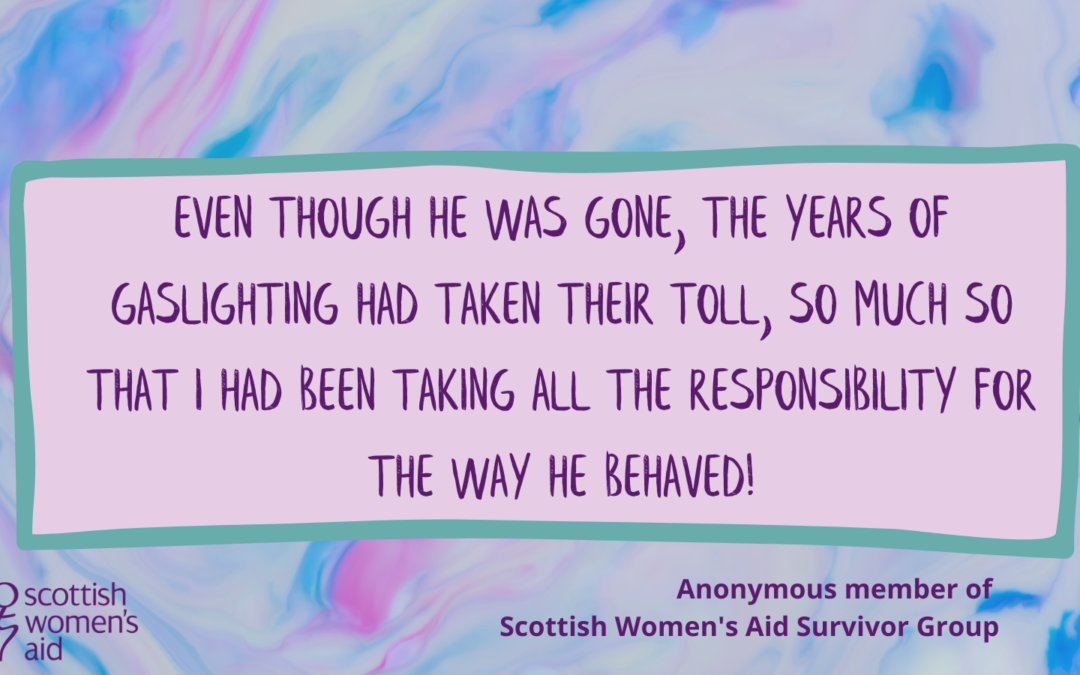
Even though he was gone, the years of gaslighting had taken their toll, so much so that I had been taking all responsibility for the way he behaved! Well, that was a revelation!
I dissected the relationship and began to discover what really happened. I’ve tried to make that sound scientific, but really it was just my girls and me, and boxes of tissues spending days trying to make sense of it all. The more things that came up, the more shame I felt. I was on the NHS waiting list for therapy and I’d been told that it would be a year before I could get help. I had to make sense of this! So, I did what any other woman with no resources does – I googled! I was amazed how much there was on the topic of shame on the internet. I was glad no-one was looking at my search history – I was even ashamed to feel shame! But, it worked – I found articles, books, Tedtalks, videos, you name it – I soaked it up like a sponge so I could get an understanding of my unwanted addiction to toxic relationships and this awful hangover. I probably shouldn’t use the word addiction, as that implies a see-saw of pleasure and pain, but these relationships I’d taken part in were more like a rollercoaster of fear and calm.
Of course, the full force of shame didn’t really hit me until I had to go to court as a witness against my ex-partner. I thought my role that day was to stand up and tell the truth, but apparently not – it seems my role was to be shamed about feeling scared, shamed about calling the police, shamed about speaking up against my abuser. The other people in the courtroom (all men) seemed not to be affected by this thing called shame.
After that day I did some more research and began to understand how, as women, we process shame in a different way to men. Men often blame their behaviour and feel ashamed of something they did, then shake it off as a bad decision. Women are more likely to blame ourselves and think there is something wrong with us, not just our behaviour, when we feel shame. Shame itself is so often what keeps us stuck and influences the choices we make. That was true for me because I decided that I wouldn’t ever place myself in a courtroom again. Another revelation for me.
As I researched more and listened to the words of intelligent women, some of whom had experienced relationships like mine, the shame began to dissolve. Like salt on ice it began happening…
- I stopped blaming myself for the actions of these abusive men I’d loved.
- I looked at the things I was most ashamed of throughout these toxic relationships though the eyes of a friend, who didn’t judge, who just watched what happened and could see what the truth was.
- I understood that, while I had made decisions out of love, my controller was often making his decisions out of self-preservation or the need to control me.
- There were millions of women the world over feeling shame.
If shame was a person, I’d have this to say to them:
“You can go now, back to the men who abuse us, to the men who threaten our children, the men who leave us in poverty (because they can), the men who cheat on us and the men who use us as a meal ticket. I, for one, am glad to see the back of you.”
If anything mentioned in this blog post resonates with you, Scotland’s Domestic Abuse and Forced Marriage Helpline is available 24/7 for support and advice. You can call free on 0800 027 1234 or email and web chat at www.sdafmh.org.uk. The Helpline is for anyone, of any gender or sexuality, who wants to discuss their experiences – even if it’s something that happened in the past. People who are worried about someone else can also call for confidential advice and support. You can also find your local Women’s Aid service here.
