

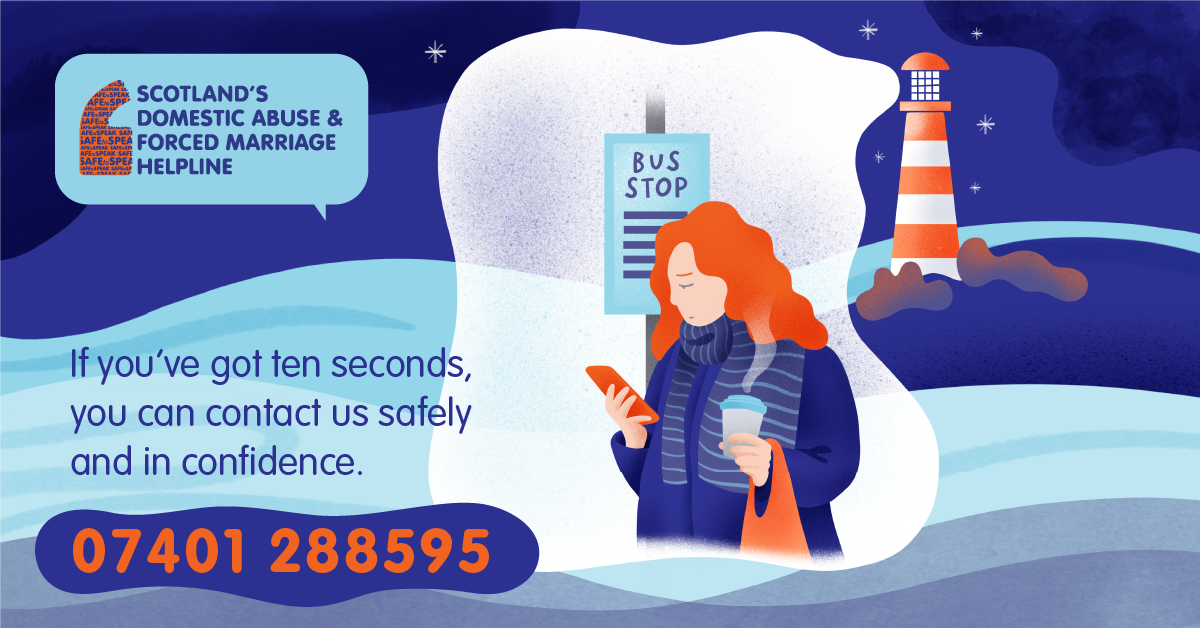
Got 10 seconds? Text us.
Scotland’s Domestic Abuse and Forced Marriage Helpline exists for anyone who is experiencing domestic abuse or forced marriage. But we know not everyone is safe to call us by phone. That’s why we’re adding a text chat service to our line-up of ways you can reach out to us.
Originally, the Helpline was available by phone or email. In 2020, we added our web chat service, which reaches 300 people every month – that’s over a quarter of the people who contact us. Not being overheard is a major reason people reach out by web chat. But because web chat needs a good internet connection and enough safe time to spend with our staff, it doesn’t work for everyone.
Imagine a woman – let’s call her Olivia. Olivia’s partner controls her movements, telling her where she can go and who she can see. He locks her phone away in a drawer when she is at home, so Olivia only has access to her phone when she is at work or on errands. She has been wanting to reach out for help, but only has short moments in the day when she can talk privately.
Now imagine Elsie, 80 years old, living in the Highlands. She wants to get away from the husband who has been abusing her for the last 50 years, but she has no internet and relies on her old Nokia phone to talk to people. She would like to call us, but worries about being overheard.
So, what do you do if you only have a few seconds of safety? And what do you do if you don’t have reliable internet access?
These were the questions that we asked when we approached the National Lottery for funding for an SMS and WhatsApp service.
And the National Lottery thought these were excellent questions and funded us for three years to find the best answers.
We started by talking to our service users – the people who know the most about what is safe and convenient in a domestic abuse or forced marriage situation. We surveyed previous callers to the Helpline, with guidance and direction from the Scottish Women’s Aid Survivor Reference Group.
A text service needs to be quick and easy, they said. It should be staffed by experts and, most of all, it must be safe.
For experts, we are already covered. All of our call handlers are specially trained.
The same people who staff our phones, email and webchat will be operating the new SMS/WhatsApp service.
Our information, advice and empathy are exactly the same, whichever way you choose to contact us.
And if you need a quick and easy reply, an SMS or WhatsApp message takes seconds to write and send, and we will receive it instantly.
That’s the beauty of text.

If Olivia only has a few seconds while she is at the till in the shop, she can drop us a message and get a reply the next time it is safe for her to look at her phone.
And you don’t need to have the internet to talk to us on SMS. Elsie’s phone will work, as will any that can make calls.
Safety is our priority. When you send us a message, the following things will happen:
- You will get an automatic reply, to let you know we’ve received the message. That reply will also include instructions about deleting our messages quickly if you need to.
- We will only ever send you one message at a time, and then wait for you to reply. If you do not reply, we will never send a follow-up message, just in case it isn’t safe.
- You can tell us when it is safe to send you messages, and we will only ever send you replies at those times.
- Our phone number shows as a random mobile number on both SMS and WhatsApp. You can name it anything you want in your phone – “Jane”, “Dog Sitter” or “Mum”.
- On WhatsApp, the conversation will not appear on any bills. On SMS, the number will be listed as the generic mobile number on itemised bills.
- You can tell us to stop sending you messages at any time. You are in control of the flow of messages.
- WhatsApp is encrypted. There is no way for anyone who does not have access to your passwords to see your conversation with us.
Because of the popularity of WhatsApp among younger people, we also consulted with young people who have experienced abuse.
As with older people, safety was paramount for them. From an SMS/WhatsApp service, they wanted:
- Emotional support
- Accurate information about domestic abuse and forced marriage
- Links and signposts of where to go for more information or support
We already provide these forms of support through our other channels, and we can’t wait to bring our skills to a new medium. This is an exciting new chapter in the life of Scotland’s Domestic Abuse and Forced Marriage Helpline. Through our new SMS/WhatsApp service, we hope to help more people experiencing domestic abuse and forced marriage than ever before.
