
by womensaidscot17 | Jun 10, 2021 | Uncategorised
Content warning: this blog post contains description of domestic abuse and sexual violence. Please read with care – information on where to find support is listed at the end of this blog.
He’d drive me to and from work and people would say “oh that’s great, he takes you places and all that “but I knew why he was doing it, it was so he knew where I was.
Scotland’s response to male violence against their wives, partners or girlfriends has come a long way since the 1970s when ‘wives’ were ‘battered’, failed to protect their children and police didn’t get involved in ‘domestics’. Forty years since the publication of Violence against Wives – A Case against the Patriarchy, new legislation – The Domestic Abuse (Scotland) Act 2018 – criminalised coercive control, and reflects Scotland’s long journey towards a deeper understanding of this complex and enduring problem.
Whatever it is called, men’s violence against women has been a reality in Scotland for centuries. My oral history research into domestic abuse in post-war Scotland shed some light on how we got from ‘battered wives’ in the 1970s to ‘coercive control’ in the 21st century. I interviewed a number of women born between the 1940s and the 1960 from the towns, cities and villages of Scotland and professionals and policy makers working in the police, courts, social work and government from the 1970s to the 1990s.
Changing times
The women I spoke to were dating, getting married or moving in with their boyfriends when Scotland was experiencing fairly dramatic and contrasting social and economic change. From the 1960s to the 1980s, the country’s traditional heavy industries declined, male unemployment rose and more women entered the workforce. In the 1960s and 1970s, progressive legislation was advancing women’s reproductive rights and equality in relation to abortion, pay, maternity leave and sex discrimination. Marriage was still the norm, despite the so-called ‘sexual revolution’ of the 1960s which had begun to challenge the conventional mores of young people’s sexual relationships.
In 1979, Margaret Thatcher became Britain’s first female Prime Minister when the new Conservative government was elected. However, Mrs. Thatcher did not express allegiance to feminism or support for women’s equality; the Conservative’s neoliberal politics were profoundly patriarchal and based on her party’s traditional family-centred values of individualism and traditional gender roles. These policies stalled the progressive trend of legislation and the promotion of women’s social and workplace rights which had begun in the late 1960s. Freedom and citizens’ rights were reframed as consumption; as Thatcher said,
…who is society? There is no such thing! …There are families and no government can do anything except through people and people look to themselves first.
Family life, work and violence
By the 1970s and 1980s, the women in my study had become teachers, nurses, accountants, health professionals, civil servants and administrators. Settling into family life, having children and women returning to work meant family incomes and standards of living gradually rose as home and car ownership, family holidays and home improvements were made possible through joint loans and mortgages. However, these same women continued to experience domestic abuse – physical, emotional, sexual and financial – whilst juggling demanding jobs, childcare, housework, parenting, family debt and the need to ‘keep up appearances’.
A new financial balance of power challenged the patriarchal family conventions which the women and their husbands had absorbed since childhood. Historically, men’s higher status in the family came from their role as the main breadwinner and violence and abuse was a common practice for enforcing the traditional family pecking order.
By the 1980s and 1990s, with women’s earnings now essential to the family budget and to maintaining their living standards, the function and the way the men used violence began to change. Easier access to credit led to home ownership and mortgages; higher spending, and mounting family debt created ever more complex family finances which further entrapped the women. Women lived their lives with the constant threat of severe physical and sexual violence and described wearing a ‘mask’ at work and in public.
Men devised new ways to extend their control as women’s working and social lives took them outwith the home on a daily basis. Cars and telephones made surveillance easier: husbands telephoned women’s workplaces to check they had arrived, drove them to and from their work and social events and were able to check itemised telephone bills.
My friends would say, ‘”D’ye know it’s so nice, he phones to see if she’s made it to her work.” I says, “Naw he wisnae phoning to see if I’d made it to work he was checking up on me”.
He used to phone the college to make sure I was there.
Men decided if women could attend social events alone; refused to look after their own children; scrutinised their partner’s clothes and insulted their appearance.
I had to show him everything I bought. If it wisnae good enough, I had to return it. If I was going out I was asked, “What are you wearing?”. If he felt the party we were at was going on and too many people were paying attention to me I was sent home wi’ the kids.
Women’s movements were monitored and curfews curtailed nights out with punishments meted out if they were late.
It’s one o’clock in the morning, a friend dropped me off after a night out with my pals and he’s standing waving at the window and I got in and I got a doin’… my whole night ruined.
Women were subjected to jealous outbursts and some were raped for speaking to other men in their husband’s presence, or because they were suspected of flirting.
I was quite attractive and I got a lot of attention and of course I would be blamed for that attention you know what I mean, you don’t have to do anything you know.
It is possible to see from these narratives how being a ‘battered wife’ in the confines of the home evolved into being subjected to ‘coercive control’ – a constant, invisible presence in every area of the women’s public and private lives.
While advances in women’s equality, better jobs and higher wages broadened women’s horizons, the violence and abuse did not end. The patriarchal legacy was alive and well and domestic abuse survived into the late twentieth century by adapting successfully to changing times.
From private violence to public prevention
The gradual emergence of a critique of domestic abuse and the need for supportive public services for women led by the Scottish Women’s Liberation, Women’s Aid and Rape Crisis movements and the work of the Dobashes began to enter the public consciousness by the late 1980s and early 1990s. However, these developments barely registered with the women I interviewed. In the absence of a widespread public debate, the women struggled to explain the abuse they were experiencing, remained fearful of disclosing the abuse to outsiders, immersed as they were in longstanding conventions of family privacy and fear of the consequences. However, while patriarchal norms were proving tenacious but adaptable to contemporary social and economic change, so too were the women.
With no help from the police or other services, with society still largely hostile to their situation and fearful of reprisals from their abusive partners/husbands, the women finally freed themselves and their children by devising carefully planned, long-term exit plans, helped only by a small circle of trusted family and friends and which they financed themselves.
The first public Zero Tolerance campaign, which launched in Edinburgh in 1992, showed Scottish women that their private hell was becoming public business.
I remember seeing big Z-Z-Zs… how empowering that would have felt to me in 1986 to have seen that, that would have just made such a difference.
The women I interviewed lived in a time of transition when public discourses and awareness of domestic abuse was in its infancy. It began to emerge as a public issue when conventions of family privacy, non-disclosure and non-interference in family business were still dominating the practices and policies of public services as well as women’s own consciousness. My research showed that the importance of having a vigorous public critique and structural explanations of domestic abuse for women living with violence and abuse cannot be underestimated. Without it, women endure in isolation. Public challenges to domestic abuse explain, reassure, offer hope and the prospect of justice.
This is the fourth in a series of essays published in spring/summer 2021 to accompany a webinar series hosted by Scottish Women’s Aid during April and May 2021. Forthcoming titles in the series:
- Police, criminal justice and social work responses to domestic abuse in post-war Scotland.
- Getting free – the impact of domestic abuse and leaving an abusive relationship in the 1960s-1990s
Dr Anni Donaldson
Twitter: @AnniDonaldson
Website: www.glasgowanni.com
If you feel scared of your partner or ex-partner, or if you are worried about someone you know, get in touch with Scotland’s 24-hour Domestic Abuse and Forced Marriage Helpline on 0800 027 1234 for support and information. You can also email and web chat from www.sdafmh.org.uk. There are translation and interpreting services available.
by womensaidscot17 | Jun 7, 2021 | Uncategorised
Content warning: this blog post contains description of domestic abuse and sexual violence. Please read with care – information on where to find support is listed at the end of this blog.
We went out for quite a while, a year, two years. Course I thought there was nobody like him, but the minute the ring was on the finger it all changed.
For teenage girls in Scotland the 1960s were anything but swinging. The 1970s punk era largely failed to deliver a revolution in dating habits; by the time young women were settling down with their boyfriends in the 1980s they would have been forgiven for thinking they had entered a Victorian time-warp – light years from Helen Gurley Brown’s Cosmo dream of women ‘having it all’. In my oral history interviews with women born from the 1940s – 1960s and professionals working in public agencies in the late twentieth century, I examined the roots and realities of domestic abuse in post-war Scotland. I tracked women’s experiences across four decades. They revealed how abuse sneaked in while couples were dating to emerge fully formed as soon as soon as they were married or moved in together. In the process, and as late as the 1980s, formerly ardent suitors shape-shifted into domestic tyrants. How did the hippie, biker, muso, student and loads-a-money guys of late twentieth century Scotland turn into old fashioned patriarchs as soon as they got the girl of their dreams?
Scotland’s Swinging 60s?
Even by the 1970s, the so-called sexual revolution, free love, the Women’s Liberation Movement, the oral contraceptive ‘pill’ and the Abortion Act of 1967 had not begun fully to trickle down to ordinary teenagers growing up in the not-so-swinging Scotland of the 1960s and 1970s. The availability of the oral contraceptive pill was not widespread at this time and there was still a stigma for single girls attending special clinics for prescriptions. Young women’s ‘respectability’ remained closely tied to public perceptions of their chastity; being unmarried and on the pill was a socially risky business. The sexual revolution was a winner for men: although it raised their expectations of young women’s sexual availability, it was at odds with the women’s willingness to respond.
All men were interested in in the sixties was sex and at that point I was terrified you know, I’d never met anybody that liked just me so I was a bit confused.
The double standard for women was clear. Throughout this period, women described their fear of the social stigma arising from public knowledge of their sexual behaviour and/or pregnancy outside of marriage and the few choices they had if things went wrong.
I’m getting a’ these flowers and I’m getting a’ these gifts… I think I was just blind. I got pregnant and I couldn’t tell my Mum and Dad so that was me. Make my bed and lie in it. I got married in 1981 and he said to me – I thought it was a joke – “That’s you bought and paid for.” That was my marriage license.
Having sex carried a strong sense of lifelong commitment for young women and of ownership for young men – women’s monogamy (not men’s) remained central to heterosexual relations whether couples were dating, cohabiting or married.
I remember thinking, ‘I’m no’ gonnae be able to be wi’ anybody else after that, I mean I’ve had sex wi’ this guy that means that him and I are gonnae be thegither for ever’ and that was gonnae be it.
By the 1980s it seemed that having sex whilst dating still permitted a young man to believe he could claim ownership of his girlfriend with marriage and children being regarded as the next natural step.
In the 70s, if you werenae married before you were twenty you were on the shelf. There was no other expectation for ye. All my pals were married and had babies…sixteen, seventeen, eighteen they were having babies you know ‘cos that was the expectation.
Ardent suitors or budding tyrants?
Long standing conventions of patriarchal marriage with traditional, highly gendered roles and responsibilities began to shape the women’s experiences of dating and began taking root in their relationships. Hearts and flowers soon gave way to a grimmer reality.
As children, women and men had been socialised into their future gender roles, these roles continued to evolve as they started dating. Very quickly, women observed the emergence of highly differentiated habits and practices, and the growing dominance of the men’s viewpoint, opinions and behaviour.
We moved in together and after about three months things started to look not quite right – it deteriorated from then on. Once, when I tried to say what I wanted to watch on television, he threw me on the bed and punched into my back.
The dawning reality of domestic abuse
Domestic abuse was experienced as a gradual and highly gendered process of entrapment whereby men’s flattery, courtship and romantic gestures flipped to increasingly violent, coercive and controlling behaviour when the couple married or moved in together. Women’s early experiences of domestic abuse and sexual violence were closely linked to the establishment of male dominance and an encroaching atmosphere of fear in the relationship. Women slowly learned to defer to the men under duress as threatening and demeaning language, looks and gestures became the norm:
You know that way you just get the look and that’s it… shit you know. So by that time obviously I knew what the look was. … I remember this vividly and so that was it. Your stomach was just churning and you were just terrified really.
The silent treatment was a common tactic lasting days and even weeks with physical assaults and rape not infrequent. The narratives illustrated the intimate workings of domestic abuse and sexual violence early in women’s relationships: the violence enforced patriarchal gender roles, gradually reducing the women’s capacity for resistance and severely limiting their freedom to control many aspects of their lives.
The women described the profound impact the nature and consequences of domestic abuse began to have on their sense of themselves,
I was looking for why it was my fault ‘cos I wisnae a good wife and I wisnae this and I wisnae that and I didn’t know what I wisnae da’en right…
They also reflected on how the dynamics of their relationships shifted and the way abuse changed them as it became a fact of life.
The physical violence, I don’t know how long it lasted but it tailed off because I learned how to play the game.
Rationalising domestic abuse
Women struggled to rationalise the abuse in a number of ways: by privileging their partners’ point of view over their own, acknowledging the men’s problems in early life and recognising the financial pressures on men.
I always sort of, bowed to his hard life, which was his excuse for being a shite basically you know.
The women were deeply confused and frightened by the men’s capricious, illogical and abusive behaviour and were often blamed for the abuse they experienced.
I could never understand it because I was always the good woman. I was always a good child, I was always biddable, I have a compliant nature. I was always compliant…
Struggling for answers, they accepted the blame and the shame as they learned to live with the everyday reality of abuse.
Refracting Scottish manliness
Working with convicted domestic abuse perpetrators in the late 1980s, one former criminal justice social worker observed that men were most concerned about their own and others’ perceptions of their manliness.
Manliness is something that men can never have enough of because it degrades. You constantly have to top up your manliness and keep proving how manly you are – so men are constantly comparing themselves to other men.
Publicly, manliness was evident in the jobs men did, their social and leisure pursuits and in their public personae. Manliness was also closely bound up with being the family provider a role woven into the post-war British welfare state, in the way national insurance, benefits and pensions were calculated. Women quickly learned that the risk of being assaulted or abused could increase if they did anything which their partner perceived as undermining them and became acutely aware of the men’s contrasting public and private faces.
He was a quiet man and everybody used tae say “that’s a great man you’ve got”, “quiet man”, “wouldnae dae any herm…”
The men were described as having distinctively different public and private faces.
He was very plausible… very sociable… everybody really liked him, thought he was good fun, great cook, great host.
He could be, well they all can can’t they, could be really charming and great father and all this sort of thing… Yeah but he was a nightmare, an absolute nightmare.
This duality extended to what went on inside and out with the home, with the longstanding patriarchal convention of family privacy and non-interference by others persisting into the late twentieth century. Abusive men could count on women not disclosing the abuse to others and women understood that they shouldn’t for fear of reprisals. ‘Manliness’ was also linked to power in intimate relationships with women.
Men have seldom advertised the ways in which authority over women has sustained their sense of themselves as men. As a general rule, those aspects of masculinity which bear most directly on the upholding of that power are least likely to be made explicit.[i]
The narratives clearly showed that women’s monogamy, men’s exclusive rights of access to women’s bodies, time and labour were central to what counted as ‘manliness’. Men used domestic abuse to enforce their customary entitlements and sustain their sense of themselves as men and to keep women tied to their traditional subservient role. Conventions of family and relationship privacy provided cover for domestic abuse from the early days of their relationships and women very quickly learned to endure in silence and confusion for fear of breaching age old conventions. Old habits were showing little signs of dying. By the 1990s, women were still making their beds and having to lie in them.
This is the third in a series of essays being posted in spring 2021 to accompany a webinar series hosted by Scottish Women’s Aid during April and May 2021. Forthcoming essay titles in the series:
- From battered women to coercive control – women’s changing experiences of domestic abuse in post-war Scotland.
- Police, criminal justice and social work responses to domestic abuse in post-war Scotland.
- Getting free – the impact of domestic abuse and leaving an abusive relationship in the 1960s-1990s
Dr Anni Donaldson
Twitter: @AnniDonaldson
Website: www.glasgowanni.com
[i] Tosh, J. (1994, January). What should historians do with masculinity? Reflections on nineteenth-century Britain. In History Workshop (No. 38, pp. 179-202). Oxford University Press.
If you feel scared of your partner or ex-partner, or if you are worried about someone you know, get in touch with Scotland’s 24-hour Domestic Abuse and Forced Marriage Helpline on 0800 027 1234 for support and information. You can also email and web chat from www.sdafmh.org.uk. There are translation and interpreting services available.
by womensaidscot17 | Apr 23, 2021 | Uncategorised
Content warning: this blog post contains details of men’s violence against women that is at times graphic. Please read with care – information on where to find support is listed at the end of this blog.
As part of my degree in MSc Applied Gender Studies at the University of Strathclyde, I have been conducting a research project for Scottish Women’s Aid, mapping the appearance of domestic abuse in Scottish news media. My findings will be shared through a series of blog posts, published on the Scottish Women’s Aid website. This is the third in that series, and my previous post can be found here.
Women in the Media
Over the past 25 years, The Global Media Monitoring Project (GMMP) has been conducting the largest monitoring project on gender-based representation in the media. The preliminary results of the 2020 report conclude that women comprised 24% of all subjects and sources in newspapers. Although this is a slight decrease from the previous report, it demonstrates a small incremental change in the representation of women in newspapers over the past 25 years.
With the GMMP in mind, throughout my research I sought to identify the representation of women in the reporting of domestic abuse in Scottish news media. Overall, women appeared particularly well in the news reporting of domestic abuse, however this is expected due to the gendered nature of the topic.
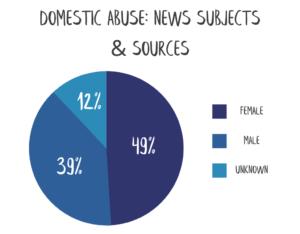
Comparing my results with those of the GMMP, it must be noted that my project focussed solely on domestic abuse in Scottish news media, whereas the GMMP covers all news media worldwide. As such, it is imperative to identify the factors which impact the appearance of women when reporting domestic abuse in the Scottish news media, such as the topic of the story, and the occupation of the person included.
My Research
The first area of analysis that I sought to uncover during my research was the gender of the journalist, but there was no clear pattern in my findings. I then identified where women appeared in domestic abuse stories, and the findings showed that women appeared on more occasions than men. In April/May 2020, there were 183 women included in domestic abuse stories compared to 128 men. In October/November 2020, there were 79 women, compared to 64 men. However, these figures must be broken down in order to fully analyse the different appearances of women in the reporting of domestic abuse.
Out of the 183 women included in stories from April/May 2020, 76 were representatives of Scottish Women’s Aid (SWA) or Local Organisations (n=23, n=53). As highlighted in my first blog post, the Scottish Women’s Aid press release at the beginning of lockdown accounted for the high number of SWA related stories in April/May 2020, which further explains the high number of women included from related organisations.
Furthermore, of the total number of times that Scottish Women’s Aid were included in news stories in April/May 2020 (n=32), they were directly quoted on 24 separate occasions. These are promising figures, as it demonstrates that when Scottish Women’s Aid appear in the reporting of domestic abuse in Scottish news media, they are more likely to be quoted directly. Including information direct from women’s organisations provides specialist knowledge in the news reporting of domestic abuse, and these figures demonstrate that journalists are engaging with well Scottish Women’s Aid’s media communications.
However, disparities began to emerge in the appearance of women in professional positions, such as Government Officials or the Police, which was also highlighted in my first blog post. Moreover, due to the gendered nature of domestic abuse, it is imperative to consider the position of women as victims/survivors in news reporting in comparison to male perpetrators. This analysis focussed specifically on use of language and how the story was framed in the news.
Perpetrators’ stories and survivors’ stories refer to the reporting of domestic abuse from the experience of the relevant position (e.g., details of the perpetrator who inflicted abuse on their partner, or from the perspective of the survivor of abuse). With regard to perpetrators’ stories, there were cases that demonstrated poor reporting of domestic abuse. As my research focussed solely on language, it became apparent that insensitive language was used to describe domestic abuse, such as the word ‘battered’, whilst also limiting the act of violence to ‘a drink-fuelled rampage’. Using alcohol as an excuse for male violence against women is a method of denying responsibility. It removes accountability from the perpetrator’s actions and suggests that violence is situation-based rather than a recurring event. Furthermore, the use of sensationalising language to describe the perpetrator, such as ‘monster’ or ‘violent brute’, detracts attention from the victim/survivor and instead, places the emphasis on the perpetrator.
Survivors’ stories, on the other hand, detailed empowering accounts from women who have experienced domestic abuse. These stories allowed women to narrate their own past experiences of abuse, which in turn can encourage women who are currently experiencing domestic abuse to seek support. Most significantly, they detailed how domestic abuse leaves lasting mental scars on survivors, long after the abuse has occurred. During my research, I discovered that a common theme throughout survivors’ stories was to heighten awareness of the everyday impact of domestic abuse, which in turn aids public understanding of the different dynamics of domestic abuse.
However, there are safety ethical issues which must be taken into consideration by journalists before interviewing survivors, and so it is vital that the appropriate safeguarding practices are established before reporting survivors’ stories. Safeguarding relates to the emotional wellbeing of the survivors when speaking about their experience to journalists, as well as ensuring the journalist’s own awareness of the dynamics of domestic abuse. This can include signposting survivors to vital support services, such as Scottish Women’s Aid, or having their own Women’s Aid worker present during the interview process.
In a world dominated by what we read online; it is crucial that the correct steps are taken when reporting domestic abuse. Therefore, it is important for journalists to consider how they frame the telling of domestic abuse, and relevant advice on the best reporting practice can be accessed on the Zero Tolerance website.
If you feel scared of your partner or ex-partner, or if you are worried about someone you know, get in touch with Scotland’s 24-hour Domestic Abuse and Forced Marriage Helpline on 0800 027 1234 for support and information. You can also email and web chat from www.sdafmh.org.uk. There are translation and interpreting services available.

by womensaidscot17 | Apr 21, 2021 | Uncategorised
Content warning: this blog post contains description of domestic abuse, addiction and suicide. Please read with care – information on where to find support is listed at the end of this blog.
Becoming a girl or a boy
Scotland remained a deeply patriarchal society into the second half of the 20th century in its laws, policy, education, religion, workplaces and culture. It was also still attached to a glorified and very male version of its history, full of violence, hard man tropes and the romanticising of warriors, explorers and political heroes. Patriarchal marriage and the traditional patriarchal family of male provider/female homemaker was the first encounter with this culture for children who began absorbing important lessons about men and women from a very early age. For those experiencing domestic abuse as children, these messages came through loud and clear. These were deeply gendered lessons which helped sustain patriarchal norms down the generations.
According to Engels, ‘the first class oppression coincides with that of the female sex by the male in monogamous marriage’. Biology determined and differentiated female and male gender roles. Historically, these roles became established in the patriarchal family, and were transmitted in the way children were socialised.
At home, girls and boys learned different ways of behaving and playing, through toys and games and in the way they were treated by adults. They watched and learned how the family money was earned and spent, who had the last word, who did the housework, who got the privileges.
Families play important roles in patriarchal endorsement both at the individual and the neighbourhood levels.
For most girls and boys, it was their Mums who looked after them and they watched as their Mums did the housework, cooking and shopping whilst their Dads went out to full time jobs and were less involved in domestic chores.
My Mum was a typical woman, left with six kids to bring up while he goes off and he doesnae have that responsibility.
Children soaked all this up.
My childhood was very traditional…I was the oldest girl, I was expected to be the carer, the babysitter, helping Mum while my two older brothers went out to play on their bikes with their mates and stuff.
In some families, violence was used to reinforce what girls were expected to do at home.
I was a wee lassie… maybe seven and you’d have homework to do and sometimes you’d forget to peel the tatties or tidy up or dae the dishes and you know I’d get beaten up for that.
Living with domestic abuse
Eight of the sixteen women I interviewed lived with domestic abuse as children. They recalled the everyday terror of living with their fathers’ unpredictable violence and its aftermath. Women described mothers so badly injured that their fathers locked them away out of sight, having to clean up their mother’s blood or looking on terrified and helpless as their fathers beat their mothers in front of them – too wee and scared to intervene.
He hid her from us. He’d beaten her that badly she couldnae see out of her eyes… we sneaked in to see her. She just put her heid out the covers, she went “you need to go!” and eventually they took her away to hospital.
Their memories of fathers destroying their cherished toys or being cruel to family pets contrasted with the outward personae of proud, dominant fathers showing off their children in public and fussing over their ‘little princesses’. While their children often went hungry or without proper clothes, bedding or home comforts, fathers spent their wages on drinking, gambling and socialising.
They always got paid on a Thursday …the money was gone, there was no food left in the house by a Sunday and basically we were starved.
Mothers struggled to care for their children in the midst of this violence.
He was bad to her and it didn’t allow her to be able to parent. She couldn’t do anything for fear…. My stepfather was a binge drinker and my mother was never without a black eye. We all lived in fear of him.
Alcohol, depression and their mothers’ suicide attempts featured prominently in some women’s childhoods with fathers using alcohol to control their mothers.
He poured drink down my Mum’s throat, my Mum wouldn’t drink. He turned my Mum into an alcoholic… She didn’t go out, my Mum didn’t drink till she was thirty odds.
There were harrowing accounts of children never knowing what to expect when they came home from school.
Ye didn’t know what you were going home to. If my Mum was going to be in fae her work, if she was lying drunk, or if she’d been beaten. That was what started happening and I presume he liked it that way. She went missing for days… she didn’t take us we’d get sent to find her.
Others recalled coping with mother attempting suicide, or disappearing on ‘benders’ sometimes for weeks at a time with many remembering their mothers being almost permanently depressed. Older girls had to grow up very quickly and learn to take their mothers’ place.
We would come in from school and find her lying on the couch with an overdose. You went up to the street and got an ambulance, she would be carted away and I would have to look after my brother. I was about ten then and I used to cook, wash, do all the household chores.
Embedded in the lessons taught by such violence was the ambivalence children felt towards violent fathers. Private cruelty and selfishness coexisted with public displays of patriarchal fatherhood: physical strength and prowess went along with the outward image of a respectable and indulgent family provider. Girls were learning that performance of gender roles was different in the public sphere from what went on at home and they began to struggle with a growing internal dissonance.The girls were learning they had to love their fathers, that they should love their fathers, despite the way they behaved at home.
I actually felt that at that age I had to learn to love my father because it wasn’t his fault and so I had to grapple with that for rather a long time.
He had a lot of good elements that he taught us but the other ones…
Girls were receiving strong but complex messages about gender roles and hierarchies and their parents’ sometimes bewildering relationship dynamics. They also watched as men took privileged positions in the family and who used violence if things were not to their liking. Parents stressed the need for clear boundaries between family life and the outside world, including its problems and its violence. Children quickly learned the importance of keeping family matters private and of maintaining an image of respectability.
When she regained consciousness after a really violent attack my mother tried to kill herself with an overdose. I ran to neighbours who called an ambulance. I knew to tell them nothing about what was wrong with my Mum or why. I kept my father’s violence a secret, and told no one.
Children were thus socialised into the habits of silence and family secrecy. Those experiencing violence knew not to tell anyone about it – that it was no one else’s business what went on between a man and his wife. Only one woman recalled the police ever being called to deal with their fathers’ violence. Working class communities in Scotland had a long-standing hostility to the police or the public authorities being involved in their lives thus adding an additional layer to family privacy.
No one called the police where I lived. No one EVER called the police.
Extended families and local communities were often aware of what was going on but married women knew they had made their bed and had to lie in it – trapped in marriages with violent men.
Devoid of support and sanctuary, children supported their younger siblings or snatched brief moments of joy with their mothers or grandparents where they could. For some, friends and school became a lifeline.
I worked really hard at school… I made some early decisions, very early on when I was five, that school was the safe place for me. I never felt safe as a child ever.
They mostly just got on with their lives absorbing these highly gendered lessons, coping with their fathers’ sometimes capricious and unpredictable violence as they went along.
Some women witnessed their mothers’ ultimately futile attempts to separate from their violent husbands. Women in this period were hampered by a welfare state based on the traditional patriarchal family of male breadwinner/female homemaker. Women had poor housing options, were often denied tenancies in their own right and faced restrictive conditions when claiming benefits. Divorce law was unreformed and expensive; women risked losing custody of their children on separation; childcare was hard to come by and expensive for those on low or part-time wages; paid work was difficult to organise around caring responsibilities. Lone mothers faced all of this alongside the stigma and isolation of divorce or separation well into the 1980s. These were the years before the creation of Scotland’s network of Women’s Aid refuges. With the patriarchal system heavily stacked against them, only two of the women’s mothers succeeded in separating; one did so after numerous attempts and the other was a teacher who earned enough to support her children. Most remained married even after their children grew up and left home and continued to be abused by their husbands. The women who could not leave experienced long-term health problems, some succumbed to alcoholism and struggled with poor mental health into old age. There was a story however of one courageous woman who, in the early 1970s, against all the odds and after many unsuccessful attempts, finally succeeded in separating while her husband was in prison.
My Mum got this letter and it says ‘Well [mum’s name] that’s me I’ll be home soon. The minute you’re reading this letter I should be walking in the door and I’m looking forward to home-made poached egg and toast.” And she looked at me and she went “Oh! He’s coming hame the day”. She looked at the date and she went, well hen it’s the morra, go and get that van… and everybody a’ came into ma Ma’s hoos that day and packed what we were taking…. but d’you know what she did? She left him a note, she left him a packet of eggs and a couple slice of bread and she went ‘Aye make yer ain’ poached egg and fucking toast! We never saw him for another year.
The biographies I examined show that from early childhood, all of the women, without exception, learned very traditional lessons about patriarchal marriage whether or not they grew up with violent fathers. Girls learned that being a girl was closely tied to unpaid domestic work – housework and childcare – and that working mothers managed a double burden of paid and unpaid work. Those women who lived with domestic abuse as children learned that their fathers had a free hand in violently enforcing highly patriarchal family regimes with impunity. The women learned very early on that it was dangerous for their mothers if they did not fulfil their traditional role; that as children they had to toe the line, and disclosing their fathers’ violence to anyone outside the family was forbidden. Patriarchal masculinity in this period continued to be closely tied to men’s traditionally dominant role as provider and head of the family. Patriarchal masculinity for married men included having wives who fulfilled their role as mothers and homemakers and ensuring the family front door quite literally kept the outside world at bay. These lessons were reinforced by neighbourhood and community customs which sustained the patriarchal family form and its right to privacy and non-interference.
These glimpses into the lives of some families in Scotland’s recent past reveal the interplay between patriarchal norms, gender roles and identities on individual lives. These oral histories provide unique insights into how children learned and absorbed key lessons about what it meant to be a girl or a boy, about the sanctity of the patriarchal family and its gendered hierarchy. The sanctity of the patriarchal family and the invisible boundaries separating its private relationships and internal affairs from the wider world became deeply embedded in childhood learning. For those children living with domestic abuse, particular lessons were absorbed about the conjunction of gender, power, violence and silence.
This is the second of five essays being posted in spring 2021 to accompany a webinar series hosted by Scottish Women’s Aid during April and May 2021. Forthcoming essays and webinar titles:
- Living with domestic abuse – women changing experiences of abuse from the 1950s to the 1990s.
- Police, criminal justice and social work responses to domestic abuse in post-war Scotland.
- Getting free – the impact of domestic abuse and leaving an abusive relationship 1960s – 1990s.
To find out more about the webinars and to book your place click here.
The next essay in this series:
Living with domestic abuse – women changing experiences of abuse from the 1950s to the 1990s.
If you feel scared of your partner or ex-partner, or if you are worried about someone you know, get in touch with Scotland’s 24-hour Domestic Abuse and Forced Marriage Helpline on 0800 027 1234 for support and information. You can also email and web chat from www.sdafmh.org.uk. There are translation and interpreting services available.

by womensaidscot17 | Apr 21, 2021 | Uncategorised
By 2010 I had been working for ten years as part of the national effort to prevent domestic abuse in Scotland. In the first decade following devolution, myself and many others were involved in implementing the new Domestic Abuse Strategy (1999) and Preventing Domestic Abuse – a national strategy (2000) at a local level. Domestic abuse became an early national priority for the new (then) Scottish Executive. The strategy and the creation of the Domestic abuse Service Development Fund established a clear policy direction, multi-agency framework and funding to realise what feminists had been calling for since the 1970s – coordinated national action against domestic abuse. Ten years on, Women’s Aid groups were receiving ring-fenced funding through local and national government and a new network of Domestic Abuse and later Violence against Women Partnerships had been created in each of Scotland’s 32 local authorities. An important element of national work was the creation of Domestic Abuse Training Consortia which built on the training which Scottish Women’s Aid Groups had been delivering to public agencies since the 1970s. My colleagues and I were closely involved in the Argyll and Clyde Domestic abuse Training Consortium. Working with a range of local and national services and agencies we set about creating and coordinating training courses for professionals working in police, social work, housing and health services. My background as a historian piqued my interest in delving back in time to look in more detail at domestic abuse in Scotland to provide a bit of historical background to the courses we were creating.
My searches kept drawing a blank for material on the post-war period with one notable exception: the research done by Rebecca and Russell Dobash and their team in Scotland and elsewhere in the 1970s formed the basis of the pioneering book, Violence against Wives – A case against the Patriarchy (1979). Important historical research has been done on domestic abuse in Scotland in the 17th, 18th and 19th centuries, Annemarie Hughes’ work on the period to 1949 and Lesley Orr’s study of domestic abuse among women in religious communities and faith groups in the 1990s – Out of the Shadows. Archive and oral history projects were commemorating the anniversaries of the Scottish Women’s Aid and Rape Crisis movements. However, there were still many gaps to be filled. If I was looking for a history of domestic abuse in late twentieth century Scotland I was going to have to write it myself. My doctoral thesis, An oral history of domestic abuse in post-war Scotland published in 2019 is the result.
I originally set out to focus on the period between the publication of Violence Against Wives in 1979 and ending with the first Zero Tolerance anti-domestic abuse campaign launched in Edinburgh in 1992. I wanted to interview anyone who had experienced domestic abuse as a child or an adult between the 1970s and 1990s or professionals who had worked with those affected. What I recorded were the rich life stories of sixteen women born between 1943 and 1967 and details of the working lives of ten professionals working. With narratives spanning the 1940s to the 1990s including biographies sometimes spanning three generations, I arrived at a different destination from the one I had first planned. The end point was a more fascinating history full of deeper insights than I would have thought possible. Feminist research works outwards from women’s experiences. Feminist oral history centers women’s voices and uncovers lives previously hidden from the history books in the interactive space of the interview room.
My research revealed another Scottish history. The women and the professionals described a world previously concealed from the public story of Scotland’s past. I heard about the everyday home lives of Scottish women and children, their experiences of school and of workplaces across almost five decades. Intimate accounts of families, parents and grandparents, friends and intimate relationships were shared as were detailed descriptions of workplace cultures and practices. My responsibility was to make sense of their lives in the wider sweep of Scotland’s post-war history, to place them into that history for the first time and to seek wider historical meaning. Their experiences provide important additions to our national story.
What I did
While domestic abuse has always had high incidence and prevalence rates, it is also estimated to be widely under-reported and a ‘hidden problem’ in Scotland and across the UK. This has been the case going back many decades and there are studies of violence against wives in the late nineteenth century which have come to the same conclusion. The big question for me was why did women not report the violence and abuse they were experiencing and what factors influenced their decisions? I approached these questions in the round using a context-specific historical approach to oral history.
My sources
I was keen to interview people’s about their childhood or adult experiences of domestic abuse in post-war Scotland and also professionals who worked with those affected at that time. I collected twenty-six oral histories and immersed myself in the archives, texts and cultural material of the post-war period.
What emerged were detailed accounts of many women’s childhoods, their parents’ and in some cases grand-parents’ life stories. Some of the women experienced domestic abuse as children and not as adults; some experienced it in their teenage relationships but not in their adult relationships; some with no abuse in their childhoods went on to experience it in their adult relationships. Some experienced it as children and in adult relationships. I spoke to professionals and activists and some of them experienced it too. Women told me about the impact of domestic abuse, why they didn’t tell anyone, how they eventually freed themselves from their husbands/partners’ abuse to rebuild their lives. They told painful, courageous, but ultimately very uplifting stories. Finding a way to make sense of these varied lives required a flexible but coherent approach to analysis.
Analysing my material
As a feminist oral historian I was looking for the interplay between women’s experiences and the wider context of the society they live in. The concept of patriarchy has been central to feminist understandings of domestic abuse since the 1970s. By the twenty-first century, the dynamics of the patriarchal system in different settings became better understood. I devised a way of examining the workings of that system in more detail across private and public life and was able to form some interesting new historical conclusions.
What I found
This introductory essay is the first of five to be posted in spring 2021, which will focus on the key themes and insights which emerged from my research. The essays are linked to four webinars hosted by Scottish Women’s Aid during April and May 2021:
- 1 – Children growing up with domestic abuse in Scotland 1950 – c.1980.
- 2 – Living with domestic abuse – women changing experiences of abuse from the 1950s to the 1990s.
- 3 – Police, criminal justice and social work responses to domestic abuse in post-war Scotland.
- 4 – Getting free – the impact of domestic abuse and leaving an abusive relationship 1960s – 1990s.
To find out more about the webinars and to book your place click here.


