
Guest post by Emma Duffy, University of Strathclyde
As part of my degree in MSc Applied Gender Studies at the University of Strathclyde, I have been conducting a research project for Scottish Women’s Aid, mapping the appearance of domestic abuse in Scottish news media. My findings will be shared through a series of blog posts, published on the Scottish Women’s Aid website. This is the second in that series, and my first post can be found here.
Content warning: this blog post contains links to news coverage of men’s violence against women that is at times graphic. Please read with care – information on where to find support is listed at the end of this blog.
Helplines
You might not think it’s important to include domestic abuse helplines at the end of a story. They can be found on google. They can be found on the Scottish Women’s Aid website. They can be found anywhere; you just have to look. So, many deem it redundant to include helplines in news reporting as they are readily available elsewhere.
However, it’s crucial that helplines are made easily accessible for women who may recognise that they, or someone they know, are experiencing domestic abuse, and media reports which touch on these issues can provide an important resource. Additionally, women who have previously experienced domestic abuse may find news articles on other women’s experiences of abuse triggering or upsetting, and so signposting those women to sources of help is equally important. Scottish Women’s Aid encourage responsible media reporting of domestic abuse following the media guidance produced by Zero Tolerance. Information of various domestic abuse helplines are provided for journalists to copy and paste direct to news reports – it’s that simple.
My Research
Throughout my research, I have identified where domestic abuse helplines were being included in Scottish news media. The results found that more than a quarter of the 249 stories I examined overall did include helplines (n=64), a step in the right direction. This varied over the two key periods researched:
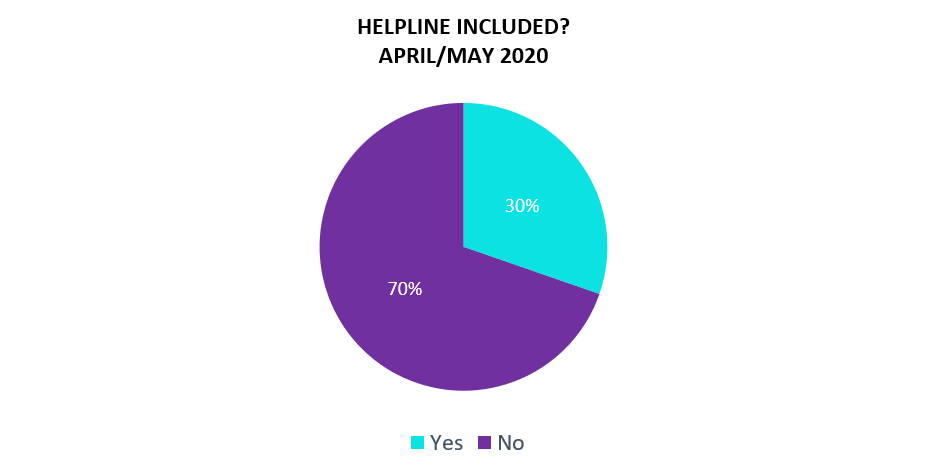
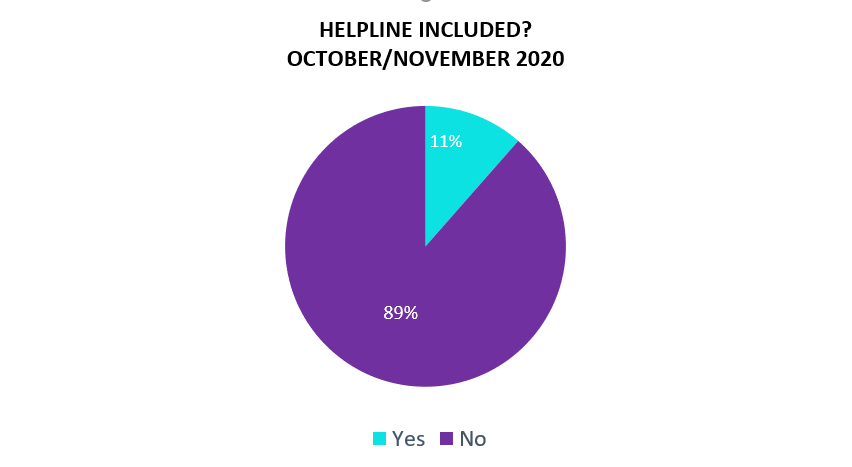
However, as the results show, the overwhelming majority of stories in both periods did not include helplines. This was due to a variety of interesting patterns that emerged during my research.
The scope of the paper impacted the inclusion of helpline information. Of all stories analysed, 18% of national papers included helplines, compared to 34% of local papers. When national papers included helplines, these were often written by the same journalist. One factor that attributed for when local papers did not provide helplines related to the topic of the story, again correlating with the role of individual journalist. A story reporting a court hearing was more likely to be written by a court reporter, who may not deem it important to include helpline information.
In terms of which kind of stories were most likely to give helpline information, the stories most likely to include a helpline were stories associated with Scottish Women’s Aid and related services. The stories that were least likely to include a helpline fell under the categories of criminal justice and perpetrators’ stories.
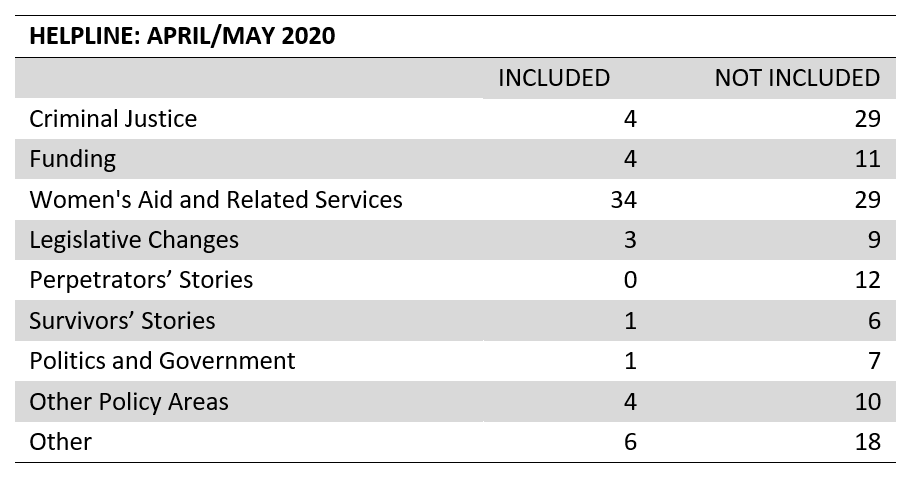
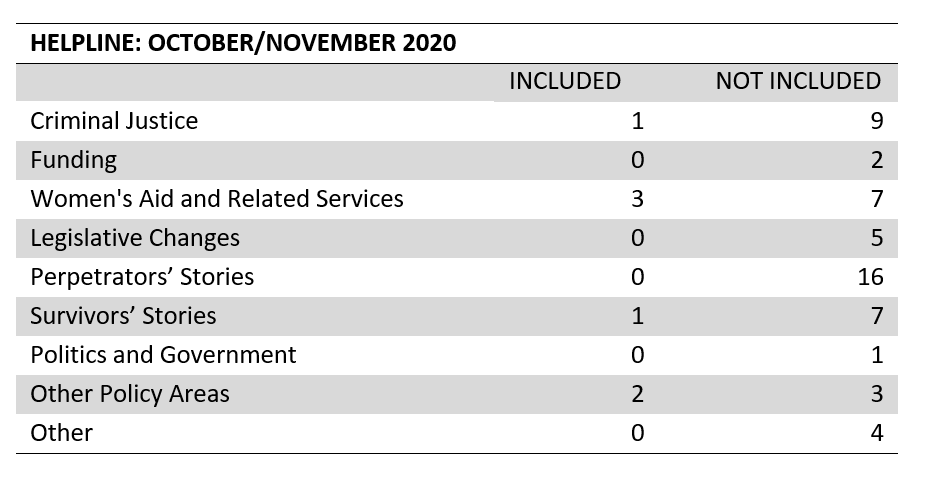
It was also alarming that a common topic within Scottish Women’s Aid related stories in April/May 2020 predicted a surge in domestic abuse cases after lockdown, and quoted Scottish Women’s Aid directly, yet did not provide further information on the services available for women. The results are even more discouraging for October/November 2020, as the majority of Scottish Women’s Aid related stories did not include helplines.
Attention must also be drawn to survivors’ stories. These stories are important in themselves as they place women directly at the centre of the narrative. Survivors’ stories are a powerful factor in encouraging women to seek help if they too are experiencing domestic abuse. However, as my research shows, there was only one survivor story for each period that included helplines, compared to the seven that did not. Survivors’ stories are crucial and could resonate with someone reading who may feel they are in a similar situation. We need to act upon that and have the resources readily available at the reader’s fingertips.
The last area of analysis that has been vital to my research was the differentiation between the national police emergency number and helplines. On various occasions, the only resource included in domestic abuse reports were the national police emergency and non-emergency numbers. Although this is a positive step in encouraging women to seek help, there are also implications of providing the emergency services number rather than the national domestic abuse helpline. For many women, calling the helpline is a means of support and a way to seek advice whilst remaining anonymous, rather than to formally report incidences of domestic abuse. Involving the police can be daunting, and whilst it is understandable that this is the most viable option in an emergency, it’s also crucial for women to be able to contact trained professionals for emotional support. Good reporting practice will include both the emergency services number and the national domestic abuse helpline.
Copying and pasting the details from the Scottish Women’s Aid or Zero Tolerance website takes under 30 seconds, and ultimately it could save someone’s life.
If you feel scared of your partner or ex-partner, or if you are worried about someone you know, get in touch with Scotland’s 24-hour Domestic Abuse and Forced Marriage Helpline on 0800 027 1234 for support and information. You can also email and web chat from www.sdafmh.org.uk. There are translation and interpreting services available.
