by womensaidscot17 | Nov 28, 2022 | Uncategorised
Scottish Women’s Aid’s campaign for 16 Days of Activism Against Gender-Based Violence 2022 is looking at the impact that the cost of living crisis is having on women and children experiencing domestic abuse and the many costs that women face – financial, emotional and otherwise – if they leave abusers. This blog post is by an anonymous member of our Survivor Group who has contributed as part of that campaign. We thank her for sharing her thoughts and experiences here.
Content warning: Domestic abuse, poverty, family court, post-separation abuse. Read with care.
The Cost of Leaving
Why didn’t you leave, they say. Why didn’t you tell us, they say. If only we had known, they say. He was always so lovely to us, they say.
While our abuser does not have to justify any action. While our abuser throws grenades from afar. We deal with the cost of leaving.
The cost of leaving is the foodbanks I use to feed my family.
The cost of leaving is the Universal Credit I now use to survive.
The cost of leaving is the home that we are imminently going to lose.
The cost of leaving is the look in my children’s eyes when I say I don’t know where we will be living at Christmas.
The cost of leaving is the car I can no longer afford to run.
The cost of leaving is the career that I gave up.
The cost of leaving is a non-existent credit score because he had full financial control.
The cost of leaving is sorting through every item of my life and deciding what I am able to keep.
The cost of leaving is the excuses I make to my children as to why they have food but I only have a drink.
The cost of leaving is not being able to replace shoes and clothes with holes in them.
The cost of leaving is selling anything, for less than it’s worth, so I can ensure my children continue with all of the activities they had when he was here.
The cost of leaving is the heating not being turned on.
The cost of leaving is the multiple phone calls I make to utilities. And. Being. On. Hold.
The cost of leaving is the humiliation every time I must disclose abuse to a faceless call handler.
The cost of leaving is the unfairness that I alone must justify every move that I have made.
The cost of leaving is the friends who will no longer speak to me.
The cost of leaving is the day spent trying to find a solicitor…”We’re sorry, we don’t do Legal Aid anymore.”
The cost of leaving is the blank eyes of a Sheriff in a family court who rules in favour of a convicted abuser.
The cost of leaving is the respite that never comes.
The cost of leaving is 3am, alone, hyper-vigilant in the silence.
Post-separation abuse is horrific but in a different way. I was always on my own even when he was here. I was always as lonely as I am now. But there was someone physically there. The finances were more stable even though they were controlled.
We are not strong. We have to be strong. We have no choice. We are broken. We are exhausted. We stretch ourselves beyond our means to be safe. But we tell our stories in the hope that it plants a seed with just one woman. We seek out our tribe. We find our voice with other survivors.
Despite all the challenges I face (of which there are many more which could be added to this list), the ultimate cost of leaving is danger and death. The hope of things being better one day is not a comfort until the fight of post-separation abuse is over.
We are resourceful and creative and no matter the financial hardships, we make it work.
If anything mentioned in this blog post resonates with you, Scotland’s Domestic Abuse and Forced Marriage Helpline is available 24/7 for support and advice. You can call free on 0800 027 1234 or email and web chat at www.sdafmh.org.uk. The Helpline is for anyone, of any gender or sexuality, who wants to discuss their experiences – even if it’s something that happened in the past. People who are worried about someone else can also call for confidential advice and support. You can also find your local Women’s Aid service here.

by womensaidscot17 | Sep 29, 2022 | Uncategorised
This September, Equally Safe in Practice (ESiP) and seven local councils from across Scotland are marking the end of a pilot phase that has seen hundreds of council staff engage with newly developed learning modules and an animation. Since 2021, Angus Council, Dundee Council, Falkirk Council, Fife Council, East Renfrewshire Council, South Lanarkshire Council and West Dunbartonshire Council have participated in a pilot to test three new learning modules in practice, which make up part of the Equally Safe in Practice framework for workforce development.
What was piloted?
Three e-learning modules – Together for Gender Equality, Understanding Domestic Abuse and Understanding Sexual Violence – and the competency frameworks that underpin them have been developed collaboratively with local and national partners in the violence against women and girls sector. The modules form the foundations of the ESiP Framework and are Group 1 of a workforce development framework that ranges from Group 1 through to Group 6, with targeted learning for each professional level. This means they’re aimed at staff across all levels, roles and responsibilities. The modules intend to build a basic understanding of gender, gender inequality and the dynamics and impact of violence against women and girls. Learners are supported to consider what they can do within their role to respond to those affected, and how they can contribute to making their organisations and communities safer and more equal.

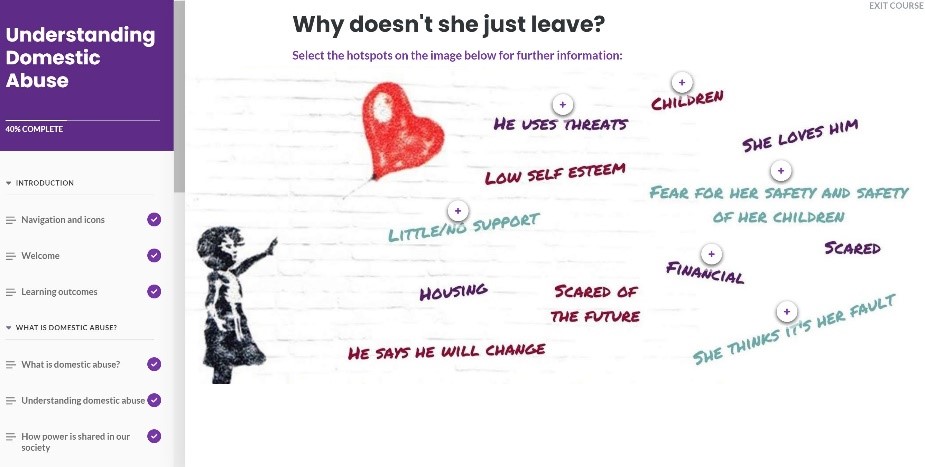
These modules focus on strengthening the everyday practice of workers across all sectors, to improve responses and outcomes for our communities – particularly women, children and young people.
Each module covers basic information about different forms of violence against women and girls, the impact on individuals and on our communities, and has a call to action which encourages learners to think about their own practice and what they could improve or strengthen.
A combination of quizzes, video, audio, case studies and reflective prompts mean that the modules take learners on an interactive journey to understand the key concepts and explore statistics, individual experiences and examples in difference contexts. Within the e-module they can also jump to a support and helpline section at any time to access information about reaching out for support or advice.
How did the pilot work?
Throughout the pilot, council steering-groups led their own approaches to testing, with different staff teams and departments engaged. Target groups ranged from housing to HR, senior leaders, social workers and managers. Councils enrolled their staff in the three e-learning modules, and coordinated follow-on discussion sessions to reflect on the key topics and consider what it might mean for them in their practice.
Some councils opted to make the modules mandatory for the pilot duration, while others targeted specific staff groups and for some it was best to open the module across departments to achieve a real mix of learners. These tailored approaches have offered ESiP the chance to look at different models for implementing the learning. For some organisations the training aligns with specific policies and priorities, whilst for others it is a complementary resource that will sit within their learning and development programme, or become part of mandatory induction. Participating councils are now exploring how these modules can be implemented going forward to have maximum impact, reach and sustainability – with support from ESiP where possible.
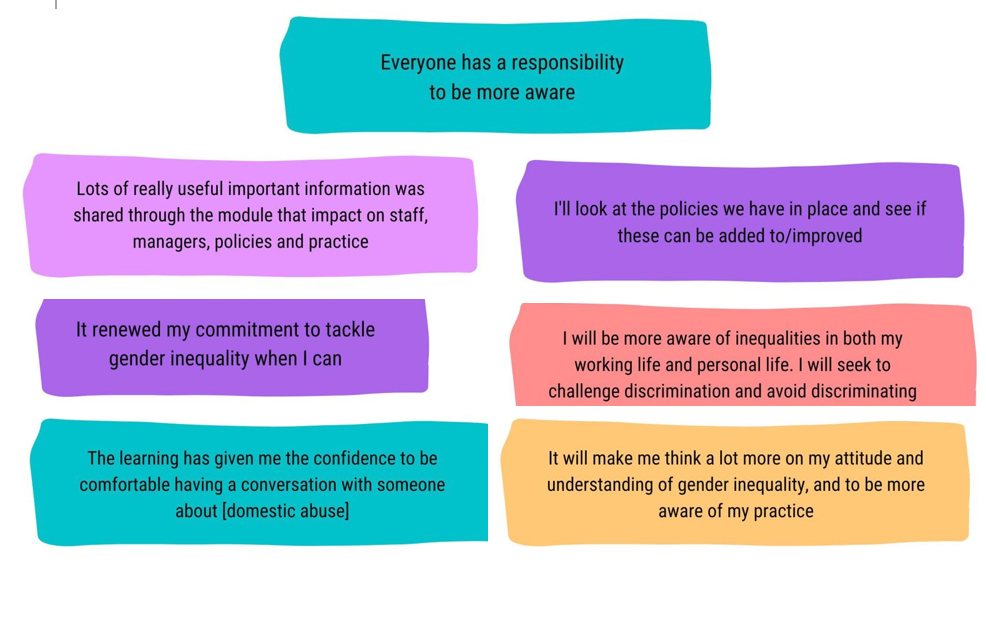
As we reach the end of the pilot phase, over 1140 learners enrolled to complete all three modules, and they have shared their feedback with us about what they have learned, what they see differently and what they intend to do next. Here is a snapshot:
 Key learning and reflections
The majority of learners reflected that each e-module had improved their knowledge and increased their confidence in talking about the core topics.
For many who responded to our evaluation survey, they could see clear ways they will use the learning in their practice – from considering their interactions with colleagues or the public more carefully, to challenging assumptions and recognising the importance of listening, believing, supporting and signposting.
For ESiP, one of the key reflections from the pilot relates to a need to find a way to embed this learning, so that these topics and concepts can be explored in more depth, and applied to practice. One-off training may help learners to increase their awareness or learn new information in the short term, but there is a critical next step to sustain that learning which needs the support of managers, leaders and the whole organisation to create an environment where learners can put that knowledge into practice.
Throughout the pilot, most councils were able to coordinate discussion sessions with their teams to reflect on what was learned and to open up different perspectives, opinions and ideas. Facilitating these spaces can be difficult when organisations and staff teams are under time and resource pressures and ESiP have needed to find new ways to support teams to have these discussions. ESiP have responded to this by creating a Module Toolkit which will accompany the modules and act as a supportive document for anyone looking to embed this learning for their teams, departments or whole organisation.
For some of the council steering groups, the learning modules and discussion spaces have contributed to an ongoing conversation about equality and violence against women and girls within their council. For others, it kick-started a new and much-needed conversation that many had assumed wasn’t needed. For one council in particular, the participation of leaders in the pilot has built an important sense of momentum and potential for change.
How can I access the modules?
From the end of this month, the modules are available to other organisations and councils looking to increase the knowledge and skills of their workers, or to embed them into their learning programmes. The modules will be accompanied by the Module Toolkit which contains an overview of the core principles of the ESiP Framework, a knowledge and skills framework for the modules and a range of different approaches, tools, resources and workshops to support reflective discussions.
To find out more or to access the modules, or if you would like to read more about the pilot phase, please contact the ESiP Administrator Gillian.Harrold@womensaid.scot

by womensaidscot17 | Aug 16, 2022 | Uncategorised
Blog post by an anonymous member of our Survivor Group. We thank her for sharing her experiences here.
Content warning: domestic abuse, shame, harm to children. Read with care. Information on where to get support is at the end of this post.
Two years ago, during the first lockdown, I told my partner to leave. It was one of the hardest things I’ve done.
His behaviour and choices were becoming more controlling and abusive and for the first time ever I saw him for what he was – a master manipulator. I also saw myself. My relationships through the course of my life, with men in particular, followed the same pattern and, whether I realised it or not, these were often abusive relationships. It was incredibly difficult for me to admit that I had spent most of my adult life loving men who were abusive. My life had been dictated by these relationships – I’d lost jobs, homes and friends. But the worst thing was the impact these relationships had on my daughters. I blamed myself 100%.
Full of disgust for myself I tried, in vain, to understand how and why I ‘chose’ men like this to form relationships with. Although I was embarrassed, I knew I had to speak out.
And so the difficult conversations began – with the police, recounting the abuse and feeling it was happening all over again. With the neighbours – awkwardly asking them “if he drives up the street and you see him before I do, please let me know.” With the emergency locksmith when I got the locks changed – “Yeah, I lost my keys, what a numpty, eh?”. With the school – “Sorry she can’t come to school today because she’s frightened that her dad will turn up again and humiliate her in the playground.”…And so it continued, reliving the abuse each time I needed to reach out to keep us safe.
But by far the most difficult conversation was with my daughters. During this conversation I did a lot of listening. It wasn’t nice. Mainly questions like “You won’t let him back again, will you?” “Why can’t I stop shaking Mum?” and, the worst one of all, “Why did you stay with him?”
The last question I honestly couldn’t answer. I didn’t know. I felt something that wasn’t just sorrow or regret. I began to realise that what I was feeling was an overwhelming sense of shame. I’d never really thought about shame before – it was something I thought happened if you were caught doing something ‘bad’, like shoplifting when you’re a kid. But this was different. This was an urgent, burning feeling and I needed to purge it.
The dictionary definition of shame is “a painful feeling of humiliation or distress caused by the consciousness of wrong or foolish behaviour.”
Painful? Yes. Humiliation? Yes. Distress? Yes. And I was absolutely conscious of my ‘wrong and foolish’ behaviour. That was me. Full of shame – inside every cell of my body and I felt SO bad for my girls. What had I done to them? Why didn’t I realise what these relationships were like? I always thought that I had put my daughter’s needs first, but I had to admit that the majority of the decisions made for my family were not made by me. I felt like a terrible mother and I just couldn’t understand why I’d never left these toxic relationships earlier. There were, of course, many reasons that made it impossible for me to leave, but that is a different story and if you’re reading this as a woman who has been trapped in a similar situation, you’ll understand.
I spoke with my local Women’s Aid worker, the police liaison officer, the social worker etc…In fact there was hardly anyone I didn’t walk with for advice and in amongst that advice was always the message that I didn’t choose this. I didn’t ask for this and I wasn’t responsible for his behaviour. Quite simply – he was! I slowly began to understand that I had been manipulated.
Even though he was gone, the years of gaslighting had taken their toll, so much so that I had been taking all responsibility for the way he behaved! Well, that was a revelation!
I dissected the relationship and began to discover what really happened. I’ve tried to make that sound scientific, but really it was just my girls and me, and boxes of tissues spending days trying to make sense of it all. The more things that came up, the more shame I felt. I was on the NHS waiting list for therapy and I’d been told that it would be a year before I could get help. I had to make sense of this! So, I did what any other woman with no resources does – I googled! I was amazed how much there was on the topic of shame on the internet. I was glad no-one was looking at my search history – I was even ashamed to feel shame! But, it worked – I found articles, books, Tedtalks, videos, you name it – I soaked it up like a sponge so I could get an understanding of my unwanted addiction to toxic relationships and this awful hangover. I probably shouldn’t use the word addiction, as that implies a see-saw of pleasure and pain, but these relationships I’d taken part in were more like a rollercoaster of fear and calm.
Of course, the full force of shame didn’t really hit me until I had to go to court as a witness against my ex-partner. I thought my role that day was to stand up and tell the truth, but apparently not – it seems my role was to be shamed about feeling scared, shamed about calling the police, shamed about speaking up against my abuser. The other people in the courtroom (all men) seemed not to be affected by this thing called shame.
After that day I did some more research and began to understand how, as women, we process shame in a different way to men. Men often blame their behaviour and feel ashamed of something they did, then shake it off as a bad decision. Women are more likely to blame ourselves and think there is something wrong with us, not just our behaviour, when we feel shame. Shame itself is so often what keeps us stuck and influences the choices we make. That was true for me because I decided that I wouldn’t ever place myself in a courtroom again. Another revelation for me.
As I researched more and listened to the words of intelligent women, some of whom had experienced relationships like mine, the shame began to dissolve. Like salt on ice it began happening…
- I stopped blaming myself for the actions of these abusive men I’d loved.
- I looked at the things I was most ashamed of throughout these toxic relationships though the eyes of a friend, who didn’t judge, who just watched what happened and could see what the truth was.
- I understood that, while I had made decisions out of love, my controller was often making his decisions out of self-preservation or the need to control me.
- There were millions of women the world over feeling shame.
If shame was a person, I’d have this to say to them:
“You can go now, back to the men who abuse us, to the men who threaten our children, the men who leave us in poverty (because they can), the men who cheat on us and the men who use us as a meal ticket. I, for one, am glad to see the back of you.”
If anything mentioned in this blog post resonates with you, Scotland’s Domestic Abuse and Forced Marriage Helpline is available 24/7 for support and advice. You can call free on 0800 027 1234 or email and web chat at www.sdafmh.org.uk. The Helpline is for anyone, of any gender or sexuality, who wants to discuss their experiences – even if it’s something that happened in the past. People who are worried about someone else can also call for confidential advice and support. You can also find your local Women’s Aid service here.

by womensaidscot17 | Jun 15, 2022 | Uncategorised
If you are experiencing domestic abuse, or supporting someone who is, and need somewhere to have a safe, private conversation, Safe Spaces are available. We understand that it can be very isolating and difficult to access support when you are experiencing domestic abuse. This scheme aims to give you an opportunity to think about options available and call a specialist support service, helpline, family member or friend. Safe Spaces are there for you to use however you need to.
More information about the Safe Spaces scheme is available here.
Safe Spaces are already set up throughout Scotland within participating Boots UK, Morrisons, Superdrug and Well Pharmacies stores, as well as within TSB and HSBC branches. They are also available in some independent pharmacies in their private consultation rooms.
How to identify a Safe Space
To find your nearest Safe Space you can use UK SAYS NO MOREs location tool, available here.
Participating stores should have displayed window stickers, posters or shelf cards to help you identify it as a Safe Space.
How to access a Safe Space
- Walk into any participating pharmacy, bank or supermarket in Scotland
- Ask at the healthcare counter/main counter in the bank to use their Safe Space
- A pharmacist or member of staff will show you to the Safe Space, which will be their consultancy room
- Once inside, you will find displayed specialist domestic abuse support information to access.
If now is not the right time for you to use the service you can come back another day, or access support via Online Safe spaces by clicking on the Safe Spaces icon at the bottom of this website. Online Safe Spaces do not show up in browsing history.
What to expect from a Safe Space
By accessing this service, you are not expected to disclose what you are experiencing to a member of staff. You will also not be expected to contact the police, unless this is something you wish to do or you are in immediate danger.
The pharmacist or staff member’s role is to show you to the consultation room and signpost you to the specialist support available. You can then use the space to think, reach out to a friend or family member or have a conversation with a specialist domestic helpline to discuss your options.
Scotland’s Domestic Abuse and Forced Marriage Helpline is available 24/7. It is free and confidential. The Helpline offers support to callers in their preferred language through a confidential interpreting service. When calling you can tell them what language you’d prefer and they will arrange this for you. They also have contact options available for callers who have hearing or speech difficulties. If phoning doesn’t feel right for you, you can also contact the Helpline on web chat or email at www.sdafmh.org.uk

Please know that you are not alone, we believe you and there is support available.
by womensaidscot17 | May 10, 2022 | Uncategorised
By Sue McKellar, Participation Lead at Scottish Women’s Aid
Women’s Aid was built on participation, right from the first refuge space being made because a woman experiencing abuse said she needed to be in a safe place. The only difference between then and now is then we didn’t call it participation, it’s just what we did. We knew instinctively it made sense to ask those who needed help, what kind of help was best for them.
When I was a refuge worker and a new family moved into the space, I would never go shopping for new toys or household items without asking them what they needed first. And yet, it was standard practice to attend meetings with funders or service leads without having a practice ‘shopping list’ given to me by the same families. 15 years ago, when I first joined Women’s Aid, it was certainly not acceptable to turn up to any external meeting with a survivor and support them to present their views.
Luckily, in the past few years I’ve noticed a real difference in the opportunities we have to include survivors alongside us when discussing practices and essentially at the core of our own internal model of working.
We are managing to bring our original way of working, where survivors sat at the table alongside paid workers, but we are adapting to safely navigate the ever-increasing demands we face.
All across Scotland, local Women’s Aid groups are engaging in creative and imaginative participation work with survivors of all ages. Some groups have advisory boards, some peer advocates. Most are doing brilliant participation work without any project titles or specific funding. But women, children and young people are having their rights respected within our sector, to help challenge the other services who ignore their rights and force them into further abuse.
At Scottish Women’s Aid, we have a newly formed survivor’s group. An incredible group of women who come together because they know first-hand the lack of understanding and supportive processes there are for those who experience domestic abuse. Without exception, these women have been let down, ignored and placed in danger, because of a wilful ignorance of services whose role it is to protect them. They are angry, hurt, passionate, strong and scared for the women and children who have yet to escape their abusers.
They are willing to use their own experiences, to relive their worse memories and to take time to explain the very basics to people who should already know better; who should know how abusers operate, and how these services can protect survivors.
They inspire me and amaze me every day. I really wish everyone could hear them speak. But you can’t. Because we do participation safely and respectfully. We won’t ask survivors to tell any of their own story, it’s their insight and advice we need. No matter how often we are asked “for a survivor to make this more real”, they are not stories for hire. And by the way, we still get asked for this – A LOT.
If you are working on a policy or trying to improve practice which impacts survivors of domestic abuse, you should definitely be including those with that experience from the very start. No work should begin to take shape without their unique and essential experience. If it starts to take shape without them, it will be the wrong shape and won’t be fit for purpose.
For this to happen, you need time (a lot), a detailed and structured plan which includes time for risk assessments, training, feedback loop and wrap around support. You need the advice of others to guide you on best practice – every participation worker I know wants to speak about their work, there’s loads of us about – just ask! You need to do your research into participation models that take a rights-based approach, and you need a budget.
Budgeting is difficult. Those of us who work in the third sector know the struggle only too well. And participation work is so difficult to budget for. Many times, I’ve sat with a line manager and said “I don’t know how long this will last, or what outcomes the group will want until we start. But can I have some money please?” and seen their furrowed brows. But if you want to do it safely and successfully you need to focus on what will make that happen. And that is care.
Demonstrate you care enough to research, plan and change your traditional way of working to ensure that those taking part are taken care of as much as they can be. The work needs a safe space where they feel confident and comfortable to share their views. But it also needs time before and after the work itself.
Imagine your worst memory. Imagine you’re going to have to think about it and possibly discuss it tomorrow for an hour, with a group of strangers and that how you do that could be the difference between other women and children being safe or not. That’s quite a lot of pressure, isn’t it?
You might not sleep the night before because you’re worried, so you’ll be tired. You might be so anxious you can’t make breakfast, or you have to drop your kids off with your mum before you go to the meeting, so you’ll be hungry. You might remember the threats your abuser made to you if you told anyone what was happening, so you’re physically shaking and a panic attack or migraine is coming on.
Then you get on a bus to the meeting. You’re asked to hand over your bus ticket for expenses. You’re given a cup of tea and a biscuit. You’re then asked to relive the most traumatic experience of your life while strangers take notes. You’re thanked and then back on the bus, alone, to sit with your memories. You’re not sure if what you said was helpful because it’s a confidential process and no end date is confirmed for publication. But you’re feeling absolutely empowered because you have the knowledge that you’re part of something that could make a difference.
That was a joke. You’re not empowered. You’re alone. You’re still tired and hungry and you’ve got to go pick up the kids because your mum can’t afford to feed them lunch again. And you have no idea if you’ve helped anyone, because you’re not part of any meeting after that one.
This is often the scenario we’re presented with. We are asked to ‘find’ survivors to talk to people without any budget at all. But our participation standards and ethics have been developed with survivors who have told us what feels safe and what doesn’t.
We know a survivor supporting our work may not have slept, so we sort out convenient transport for her. We give her mum money to buy the kids lunch if they need it. We provide food and refreshments that she likes, and we make sure she is not alone before, during or after the meeting. We make sure she receives payment, just like everyone else in the room and we always make sure she knows exactly where her words will be written and who will see them. That way, she might feel empowered and more likely to share her expertise with confidence, but she’s still very, very likely to feel all those horrible memories again. No amount of budgeting can prevent that, but it is vital to make it as safe as possible.
So, if your role or project requires you to speak to those with “lived experience” (hands up who already hates that term!?), put yourself in their shoes. Feel how small and uncomfortable those shoes are and then try your very best to make them better.
Participation work isn’t easy, it shouldn’t be easy. It’s really, really fragile and needs a lot of attention. It cannot and should not be carried out by anyone who hasn’t had a chance to learn from those who have taken part before. There are a lot of people doing it really well in Scotland, so seek them out and learn from them. Or you’ll be one of the ones that is doing it really badly. And when you do participation badly, good people get hurt.
You can find out more about Scottish Women’s Aid’s participation work by emailing survivors@womensaid.scot


